

By Nazima Raghubir
A ground-breaking study released by Guyana Trans United (GTU) is calling for the establishment of community-driven mechanisms that would enable reporting on and monitor violence against members of the LGBT community. It is also calling for systems for redress for LGBTQ people. These were among the recommendations made by GTU in its study, “Understanding violence among LGTBQ Guyanese”. The study which was made public on Wednesday was done by GTU in collaboration with Arcus Foundation.
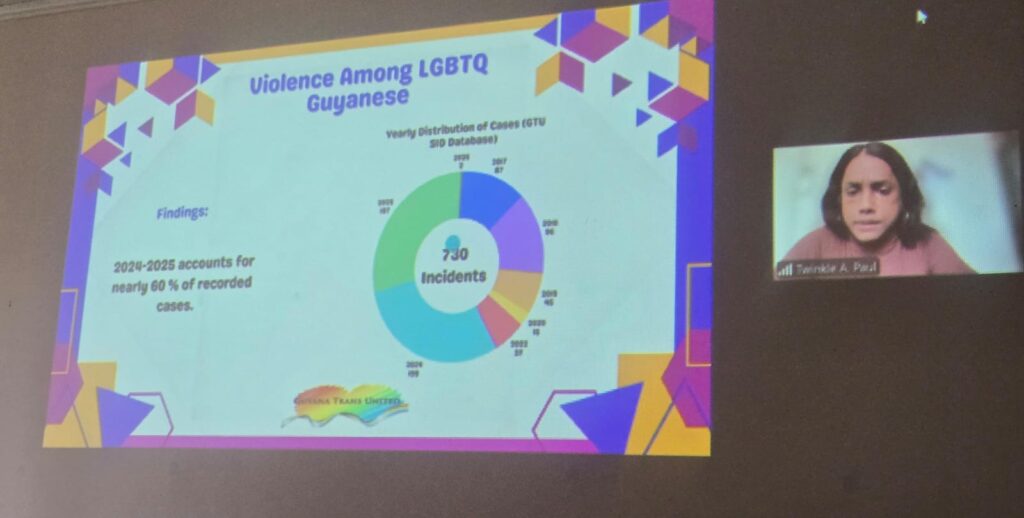
Highlighting the main findings, GTU’s Strategic Advisor Twinkle Paul explained that the study which was done between 2017 to 2025 was carried out in Regions 3,4,5 & 6 and included focus group discussions and interviews as well as reports from national and international organisations. The study found that more than 730 incidents of violence were reported with an alarming number of reports in 2024 (199) and 2025 (197) compared to the other years. Paul pointed out that many of these incidents occurred in homes, workplaces as well as the public and communities. It also found that many of these acts were committed by family members, intimate partners, o-workers as well as within schools and police stations.
The study found too, that transwomen are “disproportionately targeted by violence”. Paul explained that some 353 incidents were reported that included transwomen and some 203 incidents included gay men. Overall, the verbal harassment (30%) and physical violence (20%) as well as sexual violence and emotional abuse were recorded as the common forms of violence. As part of the study, Paul said that GTU interviewed respondents who reported “experiencing violence before the age of 18”. It noted that many of the respondents described being called names, insulted “or told not to act in a feminine manner or to act more masculine” by family members, neighbours and community members. Many of the persons who reported violence were able to “tell friends or peers” the study found with very few reporting to the police or counsellors.
GTU said that it plans to share the report with several state agencies as its recommendations suggest changes at various institutional and societal levels. Among these are the need for gender norms to be addressed “explicitly” to include those related to sexual
orientation and gender identity. It is also recommending that LGBT rights within community,
healthcare, education, and religious settings be addressed. The study is also calling for the integration of chronic care, HIV screening and care with violence screening and response services; for organisations that already support survivors of intimate partner
violence to be trained so these can also assist LGBT survivors. There is also the need for the creation of crisis-response systems for immediate, on-the-ground assistance “that can coordinate trained health, psychosocial, and legal service providers”.
GTU’s Executive Director Candacy McEwan described the report as “important” but highlighted constraints that affected its completion. This included limited data, “this was because of the lack of finances to do this type of study” McEwan said, “the lack of finances limited access to many regions and for us to meet a wider number of people.