
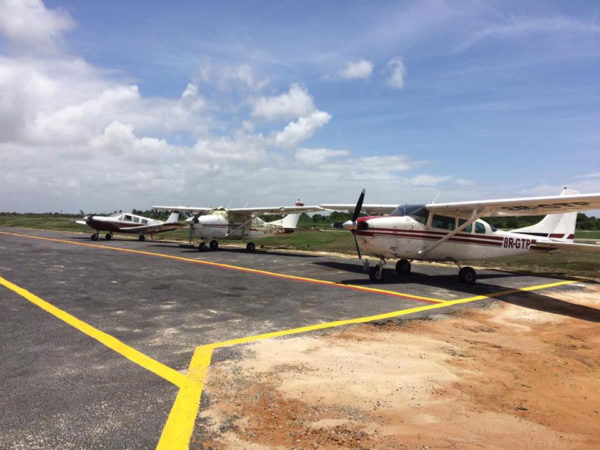
Reacting to concerns raised by President Irfaan Ali about the cost of domestic airfare, the Aviation Operators’ Association of Guyana has said it is committed to affordable, safe and sustainable air transport.
In a press release, AOAG said it has reviewed hinterland transportation costs in numerous meetings with government over recent months, including with the Ministers responsible for Finance and Aviation, examining the industry’s cost structure in detail.
The association said aircraft suitable for Guyana’s operations are expensive, citing a Cessna Caravan’s capital repayment of over US$40,000 monthly, or about US$700 per flight hour, regardless of whether the plane is flying. It said aviation insurance premiums in Guyana run roughly 300% higher than in the United States, driven by remote aerodromes, tropical conditions and short, unpaved runways.
While acknowledging government’s investment in upgrading hinterland aerodromes, AOAG said aircraft still operate on laterite and gravel strips requiring higher maintenance costs. It maintained that airfares are driven by actual operating costs, including fuel, maintenance, insurance and skilled personnel, and that competition among operators keeps prices similar across the industry, and below comparable Caribbean fares.
The association said it remains open to an independent review of the sector’s economics, and has proposed a targeted transportation assistance programme, such as a voucher system, for schoolchildren, medical referrals, pensioners and low-income hinterland residents.
The president’s comments came after the capsizing and sinking of the MV Barima, in which 73 persons lost their lives and 30 others remain unaccounted for. Government was heavily criticised over the cost of air travel to Region One communities, forcing many to use the ferry, where an adult pays $2,000, a child $1,000, and pensioners travel free.