
By Nazima Raghubir
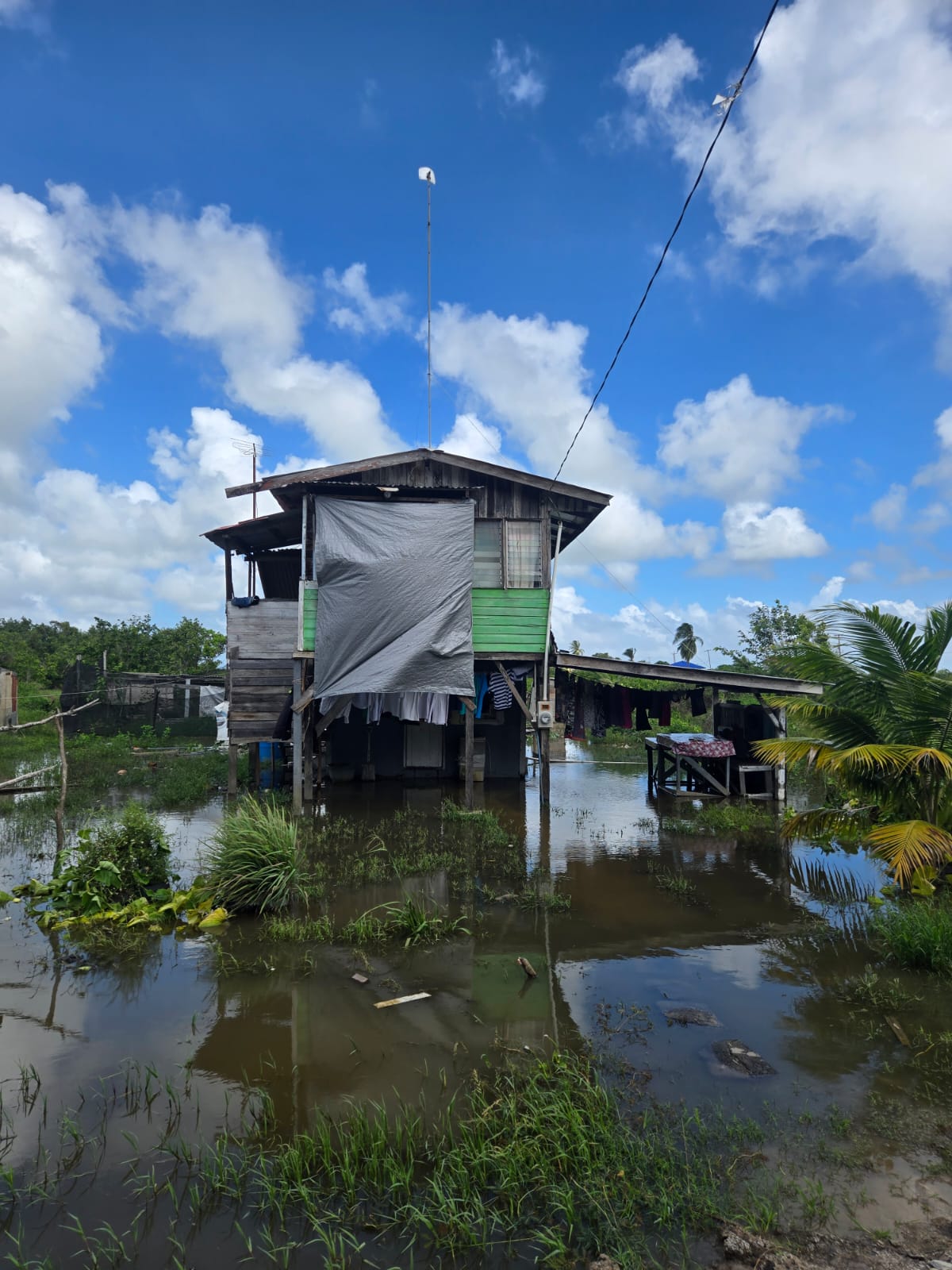
Black Bush Polder farmers continue to count their losses amidst flooding following heavy and persistent rainfall over the Christmas holidays. On Tuesday, water remained on the land affecting some homes and farmlands. While in some areas the water had receded, in other parts, water remain visible. Among the affected areas are Lesbeholden, Mibicuri, Johanna and Yakusari.
Sadesh Bisram lost his investment at Mibicuri South. Looking at the two parcels of land he planted paddy on, the man pondered his losses, “meh ah pay rent fuh dis land hay, meh a pay $65,000 fuh one land suh duh ah $170,000 with all meh investment”.
The farmer recounted that he returned to the land to work, to find that it was “duck down” or flooded. Claude Rebeiro had “18 days rice”, he now considers it all lost, “about $200,000 gone” the man estimated.
Mibikuri South resident Barbara Duncan is trying to come to grips with her losses. “I lost goat, I lost pig and greens,” a tearful Duncan said, “it’s so fatiguing to my brain right now, I didn’t think about making an estimate.”
Duncan was able to save some dry goods as she showed these were placed on makeshift planks in her small shop. The woman feels that there should be more long term solutions to target flooding in this area.
“This is happening all the time, as soon as rainfall, they keep the trench to a certain level, so the water has no where to escape,” Duncan explained, “the pump does not work the way the minister says the pump suppose to work, if you drive out, you’ll see the pump would not be working on a lot of days”.
Sherlock Garnett has been trying to pick up the pieces. His yard and home are under water and when we met him, he was trying to recover a part of his tractor which was still submerged. “I had to pick all the squash, out of all the chickens I had only one survive,” the man said.
Agriculture Minister Zulfikar Mustapha visited the farming communities earlier this week and on Sunday President Irfaan Ali said that relief measures were being implemented by the National Drainage and Irrigation Authority. These include the use of excavators and pumps.
Anil Sugrim who has been monitoring the situation feels that there needs to be a more structured approach to tackling flooding in Black Bush Polder, “it is more than a pump issue, this has been going on every rainy season,” he pointed out, “the Savannahs at the back don’t have any drainage system, the rice land pumps their water into the convervancy, the conservancy releases the water into the residential area, it comes through the residential area to the river,” he explained. The man said while the water navigates its way to the ocean, high tide would challenge the drainage.
Sugrim feels that 24- hour pumps should alleviate flooding in these communities, “if you have a dry spell and the pump need not to be worked, it would be down there and the Agriculture minister need not to take the pump out from X point and take it to Y point, they be moving this pump like if the changing clothes,” Sugrim opined.
On Tuesday, A Partnership for National Unity Member of Parliament Saiku Andrews visited the flood affected communities and cited a lack of “a comprehensive approach” to what he described as “chronic flooding”.
“Black Bush Polder continues to suffer decade after decade, year after year, rainfall season after rainfall and people continue to suffer,” the MP said. During his assessment, Andrews said residents listed loss of crops, livestock and infrastructure. “The government can point to a whole lot of billions that are spent through the Ministry of Agriculture through NAREI, emergency works, they go to Parliament, they ask for a ton of funds to initiate emergency works, but at the end of the day, there’s a gap between investment in this kind of infrastructure and the outcome,” the MP declared.
Following his assessment, Andrews said the flooding points to “a management issue” which he has linked to incompetence.
Several pumps were observed working intermittently to provide relief to the communities